


Under long-term mechanical force, the viscosity of lubricating grease will decrease. Under extremely harsh conditions, the structure of lubricating grease will be destroyed and turned into a fluid, causing it to lose its lubrication effect and lose its lubrication effect. This is because the fiber structure of the thickener, when subjected to long-term shear damage, shortens the fibers, leading to a decrease in consistency. When subjected to mild shear, the fibers can also overlap again to restore consistency. This mechanical shear performance is called the mechanical stability of lubricating grease.
Currently, two methods are used to evaluate mechanical stability.


2. The drum stability cone penetration test SH129 lubricating grease drum stability tester uses a 50g sample and works at room temperature (21-38 ℃) on the drum testing machine for 2 hours. Take enough samples from the drum and immediately place them in a quarter cone penetration tester. Then measure the working cone penetration according to the method in Part 2 of GB/T269-91. Record the working cone penetration of the lubricating grease before and after the test (Note: Convert the measured quarter cone penetration value to the full size cone penetration value)
Mechanical stability is usually represented by the difference in cone penetration between 105 and 60 working cycles. The smaller the difference, the better the mechanical stability. Generally speaking, a difference of more than 30 times is optimal, a difference of 30-60 is good, and a difference of 60-100 is acceptable.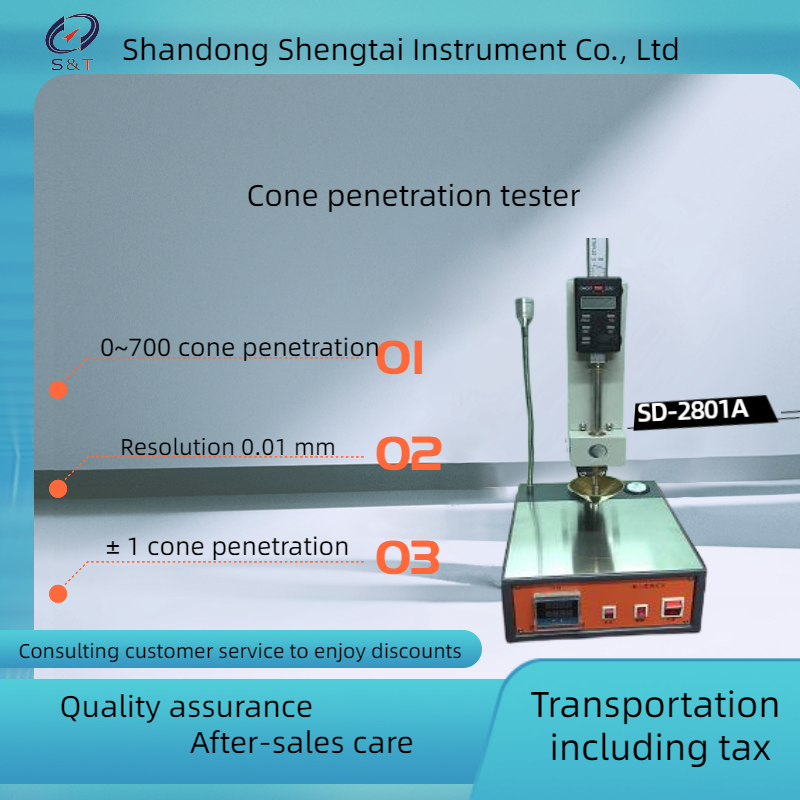
The SD-2801A cone penetration tester is designed and manufactured in accordance with the technical requirements and relevant regulations of the People's Republic of China standard GB/T269 "Measurement of Cone Penetration of Lubricating Greases and Petroleum Greases". Penetration refers to the depth at which a standard cone (usually weighing 150 grams or 100 grams) sinks into a lubricating grease sample held at 25 ℃ within 5 seconds. The unit is 1/10 millimeter. The greater the penetration, the softer the lubricating grease, i.e. the lower the consistency; On the contrary, it indicates that the harder the lubricating grease, the greater its consistency.